
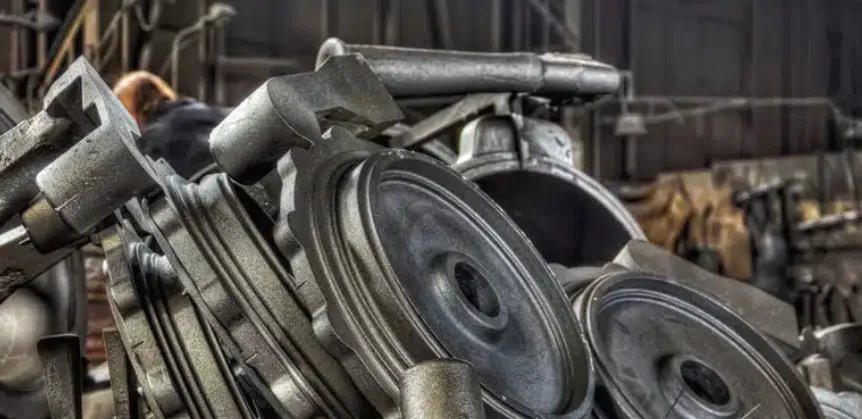
What is Cast Iron?
Cast iron is a metal composite primarily made of iron, but it is not entirely made of iron. In fact, it contains 2% to 4% carbon, which is lower than the iron content in carbon steel. This high carbon content gives cast iron its unique physical properties, making it widely used in many industries.
In addition to carbon, cast iron typically contains other elements like silicon, manganese, phosphorus, and sulfur. These elements help improve its casting ability, mechanical properties, and resistance to corrosion.
The production process of cast iron involves heating iron ore until it melts. Then, the molten material is poured into a mold with the desired shape and allowed to cool and solidify, forming a cast part. This method is ideal for making complex shapes that would be difficult or expensive to produce using other methods.
In summary, cast iron is not only a material but also a manufacturing process. Its unique combination of elements and manufacturing technique makes it an irreplaceable material in modern industries.
Properties of Cast Iron
Mechanical Properties
High Strength:Cast iron has a high compressive strength (140-350 MPa), and some high-performance cast irons can achieve even higher strength.
Hardness:Gray cast iron typically has a Brinell hardness of 170-230 HB, while white cast iron can exceed 400 HB.
Low Ductility and Toughness:Cast iron is not very flexible and tends to break easily. Its elongation at break is usually less than 1%.
Thermal Properties
Good Thermal Conductivity:Cast iron, especially gray cast iron, has excellent thermal conductivity, making it ideal for engine blocks and radiators.
Heat Resistance:Certain types of cast iron, like ductile iron, maintain good mechanical properties at high temperatures, making them suitable for high-temperature components such as boilers.
Wear Resistance
Self-lubricating:The graphite in cast iron provides a self-lubricating effect. Combined with the strengthening effect of hard carbides, cast iron has excellent wear resistance, making it suitable for parts like machine tool beds, gears, and brake discs.
Corrosion Resistance
Good Corrosion Resistance:Cast iron performs well in the atmosphere and in mildly acidic environments, thanks to the graphite content.
Vulnerable to Strong Acids and Bases:Cast iron can corrode in strong acids or bases, but proper treatment or coatings can improve its corrosion resistance and lifespan.
Machining Properties
Good Castability:Cast iron has a relatively low melting point (around 1150°C to 1250°C), good fluidity, and can easily fill complex molds, making it ideal for manufacturing large and complex parts.
Machinability:Gray cast iron is easy to machine, while white cast iron is harder and more difficult to cut.
Vibration Absorption
Damping Ability:Cast iron has good vibration-damping properties. It can effectively absorb mechanical vibrations, making it widely used in machine tool beds and other applications where vibration reduction is needed.
Cast Iron Casting
Investment casting and sand casting are two common casting methods for cast iron. Each method has its pros and cons, and choosing the right process is very important depending on the requirements and the application of the castings.
Sand Casting for Cast Iron
Sand casting is the most common casting process for cast iron production. It is suitable for castings of various sizes and shapes, especially large, complex shapes and low-volume production.
Basic Process:
- Pattern Making:First, a pattern of the desired shape of the casting is made. The pattern can be made from metal, wood, or plastic, and it is typically a negative shape of the final casting.
- Sand Mold Preparation:The pattern is placed in sand to form a mold. The sand used is usually silica sand, mixed with binders (like bentonite) and water to maintain mold strength.
- Molding and Compaction:The sand is mixed with the binder and packed around the pattern, ensuring it is compacted. To ensure a smooth surface on the casting, the mold is often polished.
- Casting:After creating a cavity in the sand mold, molten cast iron is poured into the mold and allowed to cool to form the casting.
- Pattern Removal and Cleaning:After the casting cools, the sand mold is removed, and the casting’s surface is cleaned to remove sand particles.
Lost Wax Casting for Cast Iron
Lost wax casting (also called precision casting or investment casting) is a high-precision casting method, suitable for producing complex and precise castings.
This process uses a meltable wax pattern to create an accurate casting, mainly used for small, high-precision, or complex-shaped cast iron parts.
Basic Process:
- Pattern Making:First, a pattern of the desired shape is made using wax or another meltable material. These patterns are usually created through wax injection or 3D printing.
- Coating with Refractory Material:The wax pattern is dipped into a refractory coating material multiple times and heated to cure, forming a hard shell. This process ensures the mold has high strength and can withstand high temperatures.
- Wax Removal:The shell, coated with refractory material, is heated to melt and remove the wax, leaving behind a hollow shell.
- Casting:Molten cast iron is poured into the hollow shell and allowed to cool and solidify into the casting.
- Shell Removal and Cleaning:After cooling, the shell is broken to remove the casting, and it is cleaned and surface-treated.
Sand casting is mainly used for large, complex cast iron parts and offers lower cost and higher production efficiency, making it suitable for mass production. However, its surface and dimensional precision are relatively lower.
Lost wax casting (precision casting) is suitable for highly precise and complex cast iron parts, offering excellent surface quality and high precision. It is often used for small batch production or parts requiring very high accuracy, but it is more expensive and has a longer production cycle.
Types of Cast Iron
White Cast Iron
White cast iron is very hard and wear-resistant, but it is also quite brittle. This type of cast iron contains no free graphite, instead being made of cementite and pearlite. When broken, it shows a clear white crystal surface. It is typically used in environments that require high wear resistance but where flexibility is not crucial, such as cement mixer liners and ball mills.
Gray Cast Iron
Gray cast iron is named for the gray color it displays when broken, due to the presence of flake-like graphite. This graphite provides excellent thermal conductivity and vibration damping, making it ideal for machine tool beds and engine blocks. Its carbon content is about 2.5% to 4%, and the silicon content is typically between 1% and 3%. While it has relatively low tensile strength, its good machinability and wear resistance make it widely used for industrial parts.
The key difference in ductile cast iron is the spherical shape of the graphite particles, achieved by adding small amounts of magnesium or cerium during casting. This structure improves the material’s overall strength and toughness. This high-performance material is ideal for manufacturing pressure pipes, automotive parts, and heavy machinery components. Ductile cast iron is also widely used in applications that require high durability and excellent mechanical properties.
Malleable Cast Iron:
Malleable cast iron is a white cast iron that undergoes special heat treatment. This process breaks down the cementite into ferrite and carbon nodules, greatly improving the material’s ductility and toughness. This makes malleable cast iron suitable for manufacturing complex parts requiring high toughness and good corrosion resistance, such as rear axle housings for cars and parts that bear impact and vibration loads. Its excellent performance also makes it widely used in industries such as agricultural machinery, railways, and bridge construction.
Common Cast Iron Parts
Cast iron, due to its excellent properties and versatility, is widely used in construction, transportation, and many other industries, demonstrating its lasting importance in the modern world. Among the various types of cast iron, ductile iron and gray cast iron are the most commonly used.
Based on the different types of cast iron and their characteristics, here are some common cast iron castings, including sand castings and investment castings:
White Cast Iron (White Iron)
Sand Castings:These are commonly used to make wear-resistant mechanical parts, such as high-wear rollers, crusher hammers, wear plates, and other parts exposed to heavy wear.
Investment Castings:White cast iron is also used for small precision tools and parts, like cutting tools and wear-resistant components for specific industrial applications.
Gray Cast Iron
Sand Castings:Due to its excellent machinability and vibration-damping properties, gray cast iron is widely used for large machine tool beds, automobile engine blocks, gearbox housings, machine bases, and pump and valve housings.
Investment Castings:While not commonly used for gray cast iron, it can sometimes be used for artistic or decorative castings that require fine surface quality.
Ductile Cast Iron
Sand Castings:Ductile iron, with its high strength and good toughness, is often used for manufacturing pipes, flanges, crankshafts, automotive parts (like drive shafts and differential housings), and arms or connectors for heavy machinery.
Investment Castings:It is also suitable for parts that require higher precision and complex shapes, such as complex safety parts for automobiles and high-pressure devices.
Nodular Cast Iron
Sand Castings:Due to its excellent mechanical properties, it is typically used to produce more complex and load-bearing mechanical parts, such as diesel engine blocks, compressor frames, train brake discs, and some large machine supports.
Investment Castings:Nodular cast iron is used for parts requiring fine surface quality and complex details, like precision pumps and turbines.
Malleable Cast Iron
Sand Castings:The strength and toughness of malleable cast iron make it ideal for producing various automotive components, such as rear axle housings, tractor parts, small gears, and couplings.
Investment Castings:Due to its high malleability, malleable cast iron is also suitable for high-performance parts that require post-forging, such as some specific internal automobile components.
At our casting factory, we use both investment casting and sand casting techniques to produce high-quality cast iron parts. These castings are widely used in various industries, ranging from small, complex components to large industrial parts. Our factory has rich experience in casting different types of cast iron, including gray cast iron and ductile cast iron, ensuring that each casting meets the strict standards of various industries.
With strong production capabilities, we are a leader in providing cast iron parts for the automotive, construction, and heavy machinery industries. If you are looking for a reliable partner to meet your cast iron needs, Manek Casting is here to serve you.


